

Administrative Services
Quick Answer
Administrative services are the operational support functions that keep an organization running day to day: office operations, clerical support, scheduling and coordination, records management, procurement and vendor coordination, and financial and compliance support. They can be delivered by in-house staff, an outsourced provider, an Administrative Services Organization (ASO), or a Professional Employer Organization (PEO), each with a different balance of control, cost, and scalability. Done well, they reduce overhead, keep the organization compliant, and free every other department to focus on its core mission. It is also a substantial career field in its own right: administrative services managers held about 271,200 jobs in 2024 at a median wage of $108,390, with steady growth projected through 2034.
What Are Administrative Services?
Administrative services are the operational support functions that enable an organization to run efficiently on a day-to-day basis. These typically encompass facilities management, office operations, records management, mail distribution, procurement, and vendor coordination. Effective administrative services reduce overhead, ensure regulatory compliance, and free core business units to focus on strategic objectives.
Core Administrative Services Functions
- Office Operations: Managing daily workflows, handling mail distribution, maintaining office supplies, and overseeing facility upkeep.
- Clerical & Support: Answering phones, performing data entry, processing documents, and maintaining filing systems both physical and digital.
- Scheduling & Coordination: Managing executive calendars, arranging business travel, booking conference rooms, and coordinating meetings across time zones.
- Financial & Compliance Support: Assisting with invoice processing, expense tracking, budget monitoring, and ensuring adherence to internal policies and external regulations.
- Records Management: Organizing, storing, retrieving, and disposing of business records in accordance with retention schedules and legal requirements.
Overview of Related Topics
- Key Roles: Administrative services are delivered by a range of professionals, from front-desk support staff handling day-to-day tasks to department managers overseeing operations and executive assistants coordinating at the leadership level.
- Who Uses Administrative Services: Organizations across industries (including corporations, nonprofits, healthcare providers, and government agencies) rely on administrative support across departments to sustain daily operations and meet regulatory requirements.
- Common Delivery Models: Organizations typically staff administrative functions through in-house teams, outsourced service providers, Administrative Services Organizations (ASOs), or Professional Employer Organizations (PEOs), each offering different levels of control, cost, and scalability.

Topics
Key Roles
- Administrative Assistants: Provide day-to-day clerical and organizational support to teams, departments, or individual executives.
- Administrative Services Managers: Plan, direct, and coordinate an organization's supportive services including facilities, records, and office operations.
- Executive Assistants: Handle high-level scheduling, correspondence, and project coordination for senior leadership with significant decision-making autonomy.
- Receptionists: Serve as the primary point of contact for visitors, phone inquiries, and front-desk communications.
Who Uses Administrative Services
- Small and Midsize Businesses: Rely on administrative staff to handle operational tasks that larger firms distribute across specialized departments.
- Corporate Departments: Functions such as HR, finance, legal, and sales depend on administrative support to manage workflow volume and maintain organizational efficiency.
- Government and Nonprofit Organizations: Use administrative services to manage public records, constituent communications, and regulatory compliance documentation.
Common Delivery Models
- In-House Staff: Full-time or part-time employees embedded within the organization handling administrative functions directly.
- Outsourced Providers: Third-party firms such as administrative services organizations and professional employer organizations that manage specific functions on contract.
- Administrative Services Organization (ASO): ASOs handle discrete tasks like payroll processing, benefits administration, or records management while the client retains all employer responsibilities.
- Professional Employer Organization (PEO): PEOs enter a co-employment arrangement, assuming shared liability for HR functions including tax filings, workers' compensation, and regulatory compliance.

The People Behind Administrative Services
Administrative services form the operational backbone of nearly every organization, encompassing the systems and processes that keep daily business running smoothly. This function includes managing office operations, coordinating schedules and communications, maintaining records and databases, overseeing facility needs, and ensuring that resources flow efficiently to where they're needed most. Administrative professionals handle everything from reception and correspondence to budget tracking and vendor relationships. The work exists because organizations need dedicated experts who can create order from complexity, anticipate operational needs before they become problems, and free other employees to focus on their specialized roles.
The people who excel in administrative services bring exceptional organizational skills, attention to detail, and genuine commitment to supporting others' success. These roles exist across every industry and organization size, from healthcare systems and educational institutions to corporations and nonprofits. What administrative professionals contribute goes well beyond task completion; they provide essential organizational support that directly impacts productivity, workplace culture, and business outcomes. Their expertise in managing competing priorities, solving logistical challenges, and maintaining professional standards makes them invaluable to leadership teams and colleagues alike. Organizations that recognize and invest in strong administrative talent consistently operate more effectively.

Employment Statistics & Outlook
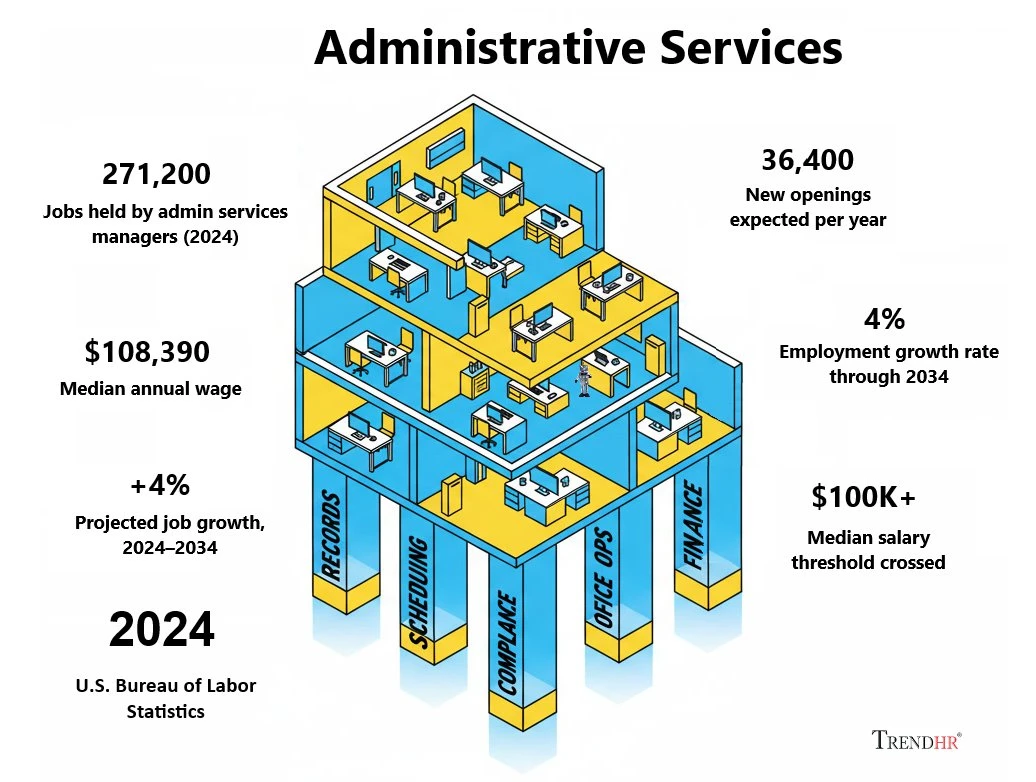
Administrative services encompass the planning, coordination, and management of support functions that keep organizations running smoothly. The U.S. Bureau of Labor Statistics (BLS) defines the Administrative and Support Services subsector (NAICS 561) as establishments engaged in activities that support the day-to-day operations of other organizations, spanning general management, personnel administration, and clerical activities. Professionals who lead these functions, administrative services managers, held approximately 271,200 jobs in 2024, earning a median annual wage of $108,390.
As Dr. Mathias Arrfelt of Arizona State University's W. P. Carey School of Business explains, these managers are key to making sure the operational aspects of any business are performed in the most efficient and effective way possible.
The demand for skilled administrative services professionals continues to grow steadily. The BLS projects employment in this field to increase by 4 percent from 2024 to 2034, with roughly 36,400 openings anticipated each year due to growth and replacement needs. These roles require a blend of operational oversight, resource management, and cross-functional leadership, from managing records and mail distribution to overseeing facility maintenance and supply procurement. Whether in healthcare, education, government, or the private sector, administrative services form the operational backbone that enables every other department to focus on its core mission.

Technology in Administrative Services
Core Technology Platforms & Systems
Modern administrative services operate on the foundation of enterprise platforms that centralize daily operations. Human Resource Information Systems (HRIS) are the backbone for managing employee records, benefits, and payroll. Office productivity suites provide the communication, collaboration, and document creation tools that administrative professionals rely on hourly. Enterprise Resource Planning (ERP) systems tie together finance, procurement, and operations, allowing administrative teams to coordinate across departments without toggling between disconnected tools.
Workflow Automation & Process Optimization
Automation is eliminating repetitive manual work across administrative functions. New tools enable teams to automate invoice routing, employee onboarding checklists, purchase order approvals, and meeting coordination.
Document & Data Management
Administrative professionals manage vast volumes of documents, from contracts and policies to correspondence and compliance records. Document management systems (DMS) provide centralized, searchable repositories with version control and access permissions. Electronic signature platforms have reduced paper workflows. Compliance considerations (including records retention schedules, HIPAA, and GDPR requirements) demand that organizations maintain clear retention policies to reduce legal exposure.
AI & Emerging Technologies
Artificial intelligence is rapidly reshaping administrative work. AI-driven scheduling assistants optimize calendar management by analyzing priorities and resolving conflicts. Intelligent document processing (IDP) tools use optical character recognition and natural language processing to extract data from unstructured documents such as invoices, receipts, and contracts. Outsourcing and automation can handle routine internal inquiries (IT help requests, HR policy questions, room bookings), freeing administrative staff to focus on higher-value tasks.
Integration & Interoperability
A persistent challenge in administrative services is the existence of data silos between HR, finance, facilities, and operations systems. Application Programming Interfaces (APIs) and integration platforms bridge these gaps, enabling real-time data flow between an HRIS, ERP, and DMS.
Skills & Adoption
Today's administrative professionals need fluency in cloud-based collaboration tools, basic data analysis, and automation platforms. Successful implementation strategies emphasize phased rollouts, executive sponsorship, hands-on training workshops, and identifying internal "champions" who model new workflows for their peers. Organizations that invest in continuous upskilling see faster adoption rates and stronger returns on their technology investments.

Key Performance Indicators (KPIs)
Administrative services functions are often perceived as cost centers, making it essential to quantify their contribution to organizational performance. Tracking KPIs transforms administrative operations from reactive support roles into strategic partners by providing data-driven evidence of efficiency, quality, and value. Well-defined metrics create accountability across teams, surface bottlenecks before they escalate, and establish a foundation for continuous improvement.
Core Operational KPIs
| KPI | Formula | Target |
|---|---|---|
| Task Completion Rate | (Tasks completed ÷ tasks received) × 100 | 95%+ |
| Average Request Turnaround Time | Elapsed time from request submission to resolution | Monitored via ticketing system |
| Office Supply Cost Per Employee | Total supply expenditures ÷ headcount | $200-$400 annually |
| Facilities Utilization Rate | (Occupied space ÷ total available space) × 100 | 40-60% (hybrid environments) |
Financial & Cost-Efficiency KPIs
| KPI | Formula | Target |
|---|---|---|
| Administrative Cost as % of Revenue | (Total admin expenses ÷ gross revenue) × 100 | 5-10% |
| Budget Variance | Actual vs. approved budget, expressed as % | ±3-5% |
Quality & Satisfaction KPIs
| KPI | Description | Target |
|---|---|---|
| Internal Customer Satisfaction Score (ICSAT) | Quarterly survey, 1-5 scale | 4.0+ |
| Compliance Audit Pass Rate | % of audits passed without major findings | As high as possible |
| Automation Adoption Rate | (Automated processes ÷ total automatable processes) × 100 | Trending upward year-over-year |
| Employee Experience Index (Admin-Specific) | Composite metric aggregating satisfaction with onboarding speed, IT provisioning, facilities responsiveness, and general administrative support | Benchmark and improve quarterly |
Monthly reporting works well for operational and financial KPIs, while satisfaction and experience metrics benefit from quarterly collection to capture trend data without survey fatigue. Effective teams pair brief monthly operational reviews with deeper quarterly strategy sessions, where leaders examine trends, investigate outliers, and assign corrective actions with clear ownership and deadlines.

Frequently Asked Questions
What Does an Administrative Services Manager Do?
An administrative services manager plans, directs, and coordinates the supportive services that allow an organization to operate smoothly. Their responsibilities typically span office management, facilities oversight, records administration, and procurement of supplies and equipment.
On a day-to-day basis, this role involves setting operational goals, managing budgets for office supplies and building maintenance, supervising clerical and support staff, and ensuring that the workplace meets safety and regulatory standards. In larger organizations, an administrative services manager may also oversee mail distribution, space planning, and vendor relationships. According to the BLS, administrative services managers earn a median annual salary of over $100,000, and the field is projected to grow steadily as organizations look for professionals who can streamline operations and reduce overhead costs.
What Is the Difference Between Administrative Services and Facilities Management?
Administrative services and facilities management are closely related but serve distinct functions. Administrative services focus primarily on office operations, business processes, and support staff coordination, while facilities management centers on the physical building environment, including HVAC systems, security, cleaning, and structural maintenance.
The key distinction lies in scope: administrative services support how people work (processes, scheduling, records, communications), whereas facilities management supports where people work (the built environment). Many modern organizations are merging these functions under a unified "workplace services" umbrella to eliminate silos and improve the overall employee experience.
How Do Companies Outsource Administrative Services?
Companies outsource administrative services by contracting with third-party providers who assume responsibility for specific support functions, ranging from reception and mailroom operations to full back-office management.
The outsourcing process typically begins with an internal assessment to identify which services are non-core yet essential; common candidates include payroll processing, document management, travel coordination, and front-desk staffing. The organization then issues a request for proposal (RFP) to qualified vendors and evaluates bids based on cost, service-level agreements (SLAs), and cultural fit. Successful outsourcing relationships depend on clearly defined KPIs, regular performance reviews, and open communication channels between the client and provider.
What Skills Are Needed for a Career in Administrative Services?
A career in administrative services requires a combination of organizational ability, communication skills, and technological proficiency.
Core hard skills include proficiency in office productivity software (Microsoft 365, Google Workspace), familiarity with ERP systems, basic budgeting and accounting knowledge, competence in records and data management, workflow automation tools, and basic data analytics. Core soft skills include strong problem-solving ability, attention to detail, interpersonal and cross-departmental coordination, leadership and decision-making at the management level, and strategic planning. Most entry-level positions require at least an associate degree or relevant certification, while management roles often call for a bachelor's degree and several years of progressive experience.
Why Are Administrative Services Important to a Business?
Administrative services are important because they create the operational infrastructure that enables every other department to function effectively.
From a financial perspective, well-managed administrative services directly reduce operating costs through efficient procurement, energy management, vendor negotiation, and waste reduction. Beyond cost savings, administrative services play a critical role in regulatory compliance and risk management: proper records management ensures the organization meets legal retention requirements, while facilities oversight keeps the workplace aligned with occupational safety standards. In an era of hybrid and remote work, administrative services teams are also at the forefront of designing flexible workplace strategies and equipping distributed employees with the tools they need.
Key Takeaways
Administrative services encompass the essential support functions (office management, procurement, records administration, and workplace coordination) that keep businesses running efficiently. Whether handled internally by a dedicated manager or outsourced to a specialized provider, these services directly influence an organization's productivity, compliance posture, and employee experience.
As workplaces evolve with hybrid models, automation, and rising employee expectations, the role of administrative services is expanding from a cost center into a strategic function. Organizations that invest in modernizing their administrative operations (through technology adoption, skilled talent, and smart outsourcing partnerships) will be best positioned to operate leaner, move faster, and create work environments where people thrive.